Pakistan–China Partnership Enters a New Era: Federal Minister Ahsan Iqbal Addresses China–Pakistan Mineral Cooperation Forum
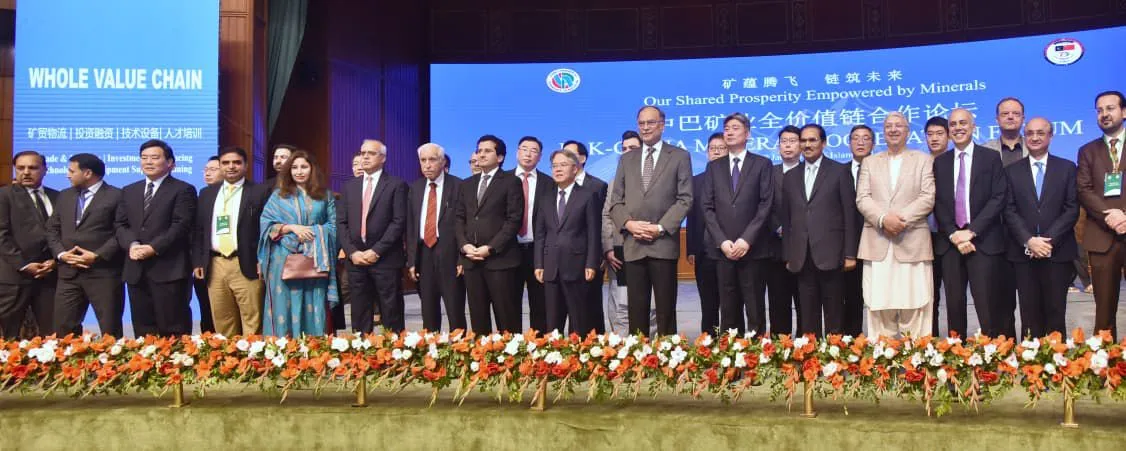 Pakistan–China Partnership Enters a New Era: Federal Minister Ahsan Iqbal Addresses China–Pakistan Mineral Cooperation Forum
Islamabad, January 28(Kamran Raja): Federal Minister for Planning, Development & Special Initiatives Professor Ahsan Iqbal said on Wednesday that the Pakistan–China partnership has entered a new era, extending beyond infrastructure development to focus on production, exports, employment generation, and sustainable growth.
Addressing the China–Pakistan Mineral Cooperation Forum, the Minister stated that on the occasion of the 75th anniversary of diplomatic relations between Pakistan and China, the partnership has become a shining example of continuity, trust, and strategic depth. He noted that the China–Pakistan Economic Corridor (CPEC) has transformed Pakistan’s development landscape through investments in energy, road infrastructure, Gwadar Port, and national connectivity.
Professor Ahsan Iqbal said that CPEC 2.0 is fully aligned with Pakistan’s national economic transformation framework, “Uraan Pakistan,” which aims to build a USD 1 trillion economy by 2035. He informed that during his recent visit to China, a Memorandum of Understanding (MoU) was signed to align Uraan Pakistan’s Five Es with President Xi Jinping’s Five Growth Corridors, ensuring coherence in planning, investment, and implementation.
The Federal Minister emphasized that the minerals sector holds a pivotal position in achieving export targets under Uraan Pakistan. Pakistan’s mineral resources are estimated to be worth USD 6–7 trillion, yet current mineral exports stand at only USD 2 billion annually . With improved governance, modern technology, and international partnerships, mineral exports can be increased to USD 6–8 billion per year, generating substantial employment opportunities.
He stressed the need to move mineral cooperation with China beyond extraction toward value addition, processing, smelting, and refining. Projects such as Saindak Copper-Gold, Duddar Lead-Zinc, and Thar Coal were cited as successful examples of bilateral cooperation, while recent investment agreements reflect growing confidence in Pakistan’s mineral sector.
Professor Ahsan Iqbal underscored that mineral development must be sustainable, environmentally responsible, and regionally inclusive , ensuring tangible benefits for resource-rich areas such as Balochistan and Khyber Pakhtunkhwa through employment, education, healthcare, and infrastructure development. He reaffirmed that the security of Chinese nationals and investments is a top priority for the Government of Pakistan, with effective measures being implemented under the Special Investment Facilitation Council (SIFC).
He invited China to invest in copper, gold, rare earth minerals, and other critical resources, with the aim of transforming Pakistan’s mineral wealth into industrial strength, export competitiveness, and shared prosperity.
Reflecting on 75 years of diplomatic relations, the Minister said that Pakistan–China ties have evolved from diplomatic goodwill into a comprehensive development partnership impacting infrastructure, energy, industry, technology, and people-to-people exchanges. CPEC, he added, remains the most visible manifestation of this partnership, contributing over 8,000 MW of energy capacity, upgrading more than 1,000 kilometers of road infrastructure, modernizing Gwadar Port, and strengthening national connectivity.
He stated that under CPEC 2.0 , cooperation has entered a new phase—transforming connectivity into production, production into exports, and exports into jobs and sustainable growth. Uraan Pakistan provides a clear roadmap toward a USD 1 trillion economy by 2035 , based on the Five Es: Exports; E-Pakistan and Knowledge Economy; Environment and Climate Change; Energy and Infrastructure; and Equity, Ethics, and Empowerment.
During the Prime Minister of Pakistan’s recent high-level visit to China, this alignment was elevated to a new strategic level through the signing of an MoU linking Uraan Pakistan with China’s development vision under the Belt and Road Initiative ensuring structured coordination in planning, investment, and execution.
The visit also featured a large-scale B2B conference, with participation from hundreds of enterprises from both countries, resulting in multiple MoUs and commercial agreements across minerals, energy, manufacturing, agriculture, IT, and logistics , reflecting a shared commitment to move from government-led vision to private-sector-driven implementation.
Professor Ahsan Iqbal noted that Pakistan possesses 92 known minerals, with 52 currently being extracted, around 5,000 active mines, and annual production of approximately 68.5 million metric tons. Despite this potential, mineral exports remain limited due to structural challenges, including only 40 percent geological mapping and the export of over 90 percent minerals in raw or semi-processed form.
Under Uraan Pakistan, he said, this situation will change. Through better governance, modern technology, and strong partnerships, mineral exports can rise to USD 6–8 billion annually, GDP growth can increase to 5–6 percent, and over 350,000 direct and indirect jobs can be created.
He emphasized that transforming Pakistan’s mineral economy is not possible without strategic partners, and China’s role is central due to its expertise across the entire mineral value chain from geological surveys and extraction to processing, smelting, refining, machinery manufacturing, environmental management, and project financing.
Pakistan, he said, offers strong geological potential, a large domestic market, improving macroeconomic stability, CPEC connectivity, and a clear industrial and export policy direction. Existing projects and recent agreements worth over USD 435 million signed at international investment forums demonstrate this momentum.
Looking ahead, Pakistan aims to establish mineral processing plants, smelters, refineries, and mineral-based industrial clusters linked with Special Economic Zones and transport corridors, serving domestic, regional, and global markets.
He reiterated Pakistan’s commitment to responsible, inclusive, and environmentally sustainable development, emphasizing strong environmental standards, efficient water management, waste control, and community participation in line with global ESG standards.
Concluding his address, Professor Ahsan Iqbal said that the future of China–Pakistan mineral cooperation lies in technology, innovation, human capital development, and long-term partnerships. He invited Chinese enterprises to play a leading role in copper, gold, antimony, tungsten, rare earth elements, and other critical minerals essential for clean energy and advanced manufacturing.
“Countries that successfully transformed their economies combined natural resources with strong governance, modern technology, and strategic partnerships. Pakistan is determined to follow this proven path. With China as a trusted partner, we can transform mineral wealth into industrial strength, export competitiveness, and shared prosperity,” he said, expressing confidence that the forum would help translate this shared vision into action.