Exclusive Conversation with Ambassador Masood Khan
Exclusive Conversation with Ambassador Masood Khan
Former Ambassador of Pakistan to the United States, China and the United Nations; Former President of Azad Jammu and Kashmir
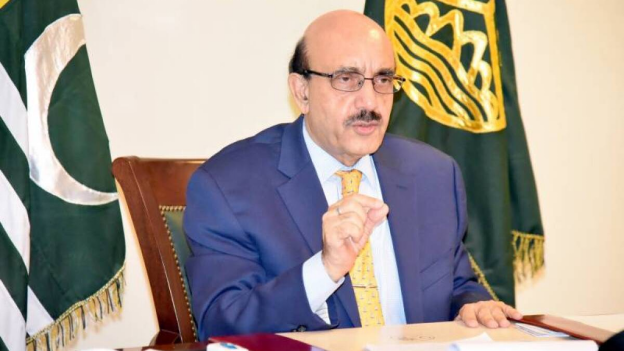
Masood Khan said that Pakistan has decades of experience in maintaining a balance between its relations with China and the United States, emphasizing that no relationship with any Western country, especially the United States, would come at the expense of Pakistan’s deep and enduring partnership with China. In an exclusive conversation with “Huashang News”, Former Pakistani Ambassador to the United States, China and the United Nations and former President of Azad Jammu and Kashmir, Ambassador Khan discussed the broader geopolitical implications of tensions involving Iran, the United States, and Israel for regional stability and energy security, Pakistan’s diplomatic balancing between Iran and Gulf partners such as Saudi Arabia, Islamabad’s counterterrorism operations against militant groups operating from Afghanistan, and the prospects for mediation to reduce cross-border tensions. He also addressed the progress and future prospects of the China-Pakistan Economic Corridor, regional connectivity initiatives linking Central Asia with Pakistani ports, and Pakistan’s strategy of maintaining balanced relations with major global powers while strengthening its long-standing strategic partnership with China. Here are the details of the interview conducted by Huashang News:
Q1: What are the implications of the Iran–US–Israel war for Pakistan and China?
Ambassador Masood Khan: This war is devastating, and its impact on both Pakistan and China is far-reaching and very serious. These are not only indirect costs; they are direct costs.
In Pakistan’s case, Iran is our immediate neighbor and we share a border. If this conflict expands, as it seems to be doing, the danger is that Pakistan could suffer strategically and economically. Pakistan has very close ties with Saudi Arabia and the broader Gulf region. At the same time, Iran has come under attack from the United States and Israel, and Pakistan has condemned those attacks.
Iran, in defending its sovereignty and territorial integrity, has been striking American bases in the Gulf region. In addition to these bases, areas that Iran perceives as threatening its security are also being targeted. Therefore, Pakistan has to maintain a delicate balance between Iran and the Gulf states.
We must also remember that Pakistan has a strategic mutual defense agreement with Saudi Arabia. In that sense, an attack on Saudi Arabia would effectively be seen as an attack on Pakistan, and vice versa.
Another important factor is that Iran is our neighboring country, so whatever happens there, whether the war continues for a long time or there is, hypothetically, a change in the political system or leadership, will deeply impact Pakistan.
There are several reasons for this. First, Pakistan’s Shia population constitutes roughly 20 percent of the country’s population. Second, as a Muslim country, Pakistan shares religious and cultural solidarity with the people of Iran. There are also strong linguistic and cultural connections; for instance, the Urdu language has borrowed extensively from Persian. Trade would also be affected, and indeed, it is already being affected.
Furthermore, energy supplies are a critical concern. For economies such as Pakistan’s, oil, gas, and LNG are vital. We hope that global oil supplies will not be disrupted for a prolonged period.
Turning to China, it is a major stakeholder in the Middle East and particularly in Iran. China purchases nearly 90 percent of Iran’s oil, so this war directly affects China’s energy supply lines. The two countries also have close economic and technological ties. At one point, China pledged around $400 billion to help build infrastructure in Iran.
Therefore, the war being waged by the United States and Israel affects China directly as well, because it restricts China’s access to oil supplies from countries like Iran and Venezuela. Together, the oil reserves of Iran and Venezuela account for roughly 31 percent of the world’s oil reserves.
China also advocates a rule-based international order established after the Second World War and symbolized by the United Nations. Statements from Beijing, whether from the Chinese Foreign Ministry or senior officials, indicate that China believes this war lacks authorization under international law and has not been sanctioned by the United Nations Security Council.
We hope that the war will not expand further. Some mediation efforts are underway, and I would encourage China and the Russian Federation to play a constructive role behind the scenes. President Xi Jinping and President Trump are reportedly scheduled to meet later this month or in early April, and such engagements could encourage the United States and Israel to move toward ending these attacks on Iran.
Iran, after all, believes its territory is under attack and therefore sees little option but to defend itself. China, on the other hand, consistently advocates peace, security, and non-interference in the internal affairs of other countries.
China possesses significant strategic weight internationally, but it must also remain cautious because it does not want tensions from the Middle East to spill over into the Asia-Pacific region.
Q2: Pakistan has a defense pact with Saudi Arabia. If Iranian attacks on Saudi Arabia continue, could Pakistan join Saudi Arabia and other Gulf countries in military action against Iran?
Ambassador Masood Khan: Even the Arab countries themselves are acting prudently and showing restraint. They are unlikely to retaliate directly.
There are two main reasons. First, Iran is already under attack by the United States, which possesses the most powerful military force in the world. Second, Israel is one of the most militarily capable states in the Middle East. The combined military power of the United States and Israel is formidable.
Therefore, Gulf States may not feel the need to escalate militarily. Instead, they may continue urging both Iran, Israel and the United States to end the war.
As for Pakistan, theoretically, if attacks on Saudi Arabia continue, the two countries could hold mutual consultations and develop a joint strategy. However, Pakistan is currently playing another important role, that of diplomacy.
Pakistan is engaging both Riyadh and Tehran. It is urging Saudi Arabia to exercise restraint while also appealing to Iranian authorities not to target civilian installations in Saudi Arabia. It is worth noting that among the Gulf countries, those that have faced the maximum number of attacks include the United Arab Emirates, Qatar, Oman, Bahrain, and Kuwait. If one compares the number of attacks, Saudi Arabia has faced fewer Iranian strikes compared with some other Gulf States.
Overall, this war frenzy should come to an end. Pakistan can play a constructive diplomatic role in facilitating dialogue, encouraging an early ceasefire, and helping resolve long-standing disputes between the United States and Iran.
Q3: Regarding the Pakistan–Afghanistan conflict, how long do you think Pakistani airstrikes will continue? Is there any possibility of mediation to resolve the issue of terrorism originating from Afghan territory?
Ambassador Masood Khan: Pakistan is not attacking Afghanistan as a state. Rather, Pakistan is targeting the hideouts and training camps of terrorists who are using Afghan territory to launch attacks inside Pakistan.
Since 2021, thousands of Pakistani civilians, soldiers, and security personnel have been killed in terrorist attacks carried out by groups operating from Afghan soil. Pakistan’s operations are therefore precise and targeted; they are not directed at the Afghan Taliban government itself. However, Afghan Taliban forces have attacked Pakistan along the long frontier between our two countries, which stretches approximately 2,600 kilometers. They opened this front through repeated attacks, and Pakistan had to respond.
Regarding diplomacy, Pakistan has already exhausted all channels. We repeatedly engaged with the Afghan Taliban leadership in Kabul and Kandahar, urging them to dismantle the networks of Tehrik-e-Taliban Pakistan (TTP) operating from Afghan territory. While the Taliban leadership made assurances from time to time, they have now come under the influence of India and are allowing these groups to target Pakistan. This is particularly regrettable because Pakistan supported the Taliban both in the 1990s and during the war on terror.
The second option we pursued was third-party mediation. China played a constructive role by hosting meetings between the foreign ministers of Pakistan and Afghanistan. China also proposed extending the China-Pakistan Economic Corridor (CPEC) into Afghanistan so that regional countries could focus on economic cooperation rather than conflict.
Pakistan also engaged Central Asian partners, including Uzbekistan. Our vision was to establish a rail link connecting Uzbekistan through Afghanistan to Pakistan, providing Central Asian states access to warm waters through Pakistani ports.
For some time, the Taliban appeared cooperative, but later developments changed that dynamic. India has a presence in Afghanistan and has been using proxies there. According to UN Monitory Committee Report, groups such as TTP, Daesh, BLA, and remnants of al-Qaeda are targeting Pakistan from Afghan territory.
China has also expressed concern about these groups. For example, the East Turkistan Islamic Movement (ETIM) has previously carried out attacks in China’s Xinjiang region, and its elements have trained in Afghanistan. The Wakhan Corridor connects Afghanistan with China’s Xinjiang region, which raises additional security concerns.
The third channel Pakistan used was mediation through Qatar and Turkey. Talks were held in Doha and later in Istanbul, and at least three rounds of discussions took place. Unfortunately, these efforts did not produce concrete results.
Since April 2025, Pakistan has effectively been in a state of war. In May of that year, there was a war with India in which Pakistan successfully defended itself, after which a ceasefire was agreed upon.
However, India has declared that it has merely paused its “Operation Sindoor” against Pakistan and could resume hostilities in the future. Pakistan believes that while there may be no direct kinetic activity on the eastern border, India is attempting to destabilize Pakistan through terrorism emanating from the western border.
Despite these challenges, Pakistan’s armed forces and the people of Pakistan are firmly resisting this wave of terrorism.
Q4: There are perceptions that China–Pakistan relations, particularly CPEC, have slowed down in recent years. What are the real reasons? And will growing U.S. involvement in Pakistan’s mineral sector affect Pakistan–China relations?
Ambassador Masood Khan: There are two parts to this question. First, regarding the China–Pakistan Economic Corridor, there is a widespread perception that CPEC has slowed down. This is not factually correct.
CPEC was inaugurated in 2015 during the visit of President Xi Jinping to Islamabad. Initially, China committed $46 billion to various projects. Of this amount, about $12 billion was extended as credits to Pakistan, while the rest was invested directly in infrastructure projects. Early harvest projects were identified, and most of them have been completed successfully. These include power plants, road construction, and the development of the Gwadar port.
There were two main interruptions. The first occurred during a political transition in Pakistan, when some individuals began second-guessing the project. China wanted assurances that the new government would fully own and support the initiative.
The second interruption was caused by the COVID-19 pandemic. The pandemic disrupted global supply chains and halted many projects worldwide, including those in China itself. Although the initial shutdown lasted about two years, the aftershocks continued for some time.
However, last year Prime Minister Shehbaz Sharif visited Beijing and met Chinese Premier Li Qiang during the Shanghai Cooperation Organization summit. Both sides reaffirmed their commitment to CPEC 2.0.
By 2017, the overall value of CPEC had already increased from $46 billion to about $62 billion. According to conservative estimates, approximately $25 billion has already been invested in projects across Pakistan. During the prime minister’s recent visit, both countries also signed additional agreements worth roughly $9 to $10 billion. These developments demonstrate that CPEC remains a flagship project and continues to move forward. It's a flagship project. It has to succeed. It will succeed.
India has openly opposed CPEC, and there are reports suggesting that efforts are being made to create doubts about the project within Pakistan. Some Western countries are also skeptical of CPEC and the broader Belt and Road Initiative (BRI), which now spans around 140 countries.
Nevertheless, both Pakistan and China remain fully committed to the success of CPEC.
Second, I would say that China is our time-tested, all-weather friend. We have been through many vicissitudes in international politics, but our friendship has remained steadfast. There has been no cycle of peaks and troughs. It has been, you have seen consistent progression in our relations.
And China does a lot for Pakistan. No, other country would do things like that.
For instance, they provided us with their sophisticated aircraft, also submarines, frigates, or tanks, other missile technology from time to time.
I served in China. I lived in China for eight years, but I served in China as ambassador also for four years, so I knew China a lot. And they go out of the way to help Pakistan.
Regarding Pakistan’s relations with the United States, these relations date back to the 1950s. There have been ups and downs, often influenced by the U.S. tilt toward India. During the Biden administration, relations were somewhat subdued, although many U.S. departments and members of Congress supported engagement with Pakistan.
However, after the war of May 2025, there has been a noticeable improvement in U.S.–Pakistan relations. President Trump has shown greater receptiveness toward Pakistani leadership and has encouraged stronger bilateral engagement. Pakistan’s strategic importance in South Asia, Central Asia, and the broader Middle East makes it an important partner for regional stability.
At the same time, I want to convey to our Chinese friends in Beijing, to their think tanks or their policymakers or opinion leaders, is that Pakistan has 60 to 70 years-long experience of maintaining a balance between our relations with China and the United States. Pakistan has shown maturity. No relationship with any Western country, or especially the United States, would be at the expense of our deep and enduring relationship with China.
Pakistan will continue to expand partnerships with Western countries, Gulf States, and East Asian countries while maintaining its strong strategic relationship with China. Pakistan is a large and significant country with a bright future, and it will continue to pursue balanced and constructive relations with all major partners.
Tahir Murtaza